


Client expectations around communication have fundamentally shifted. Today, high-net-worth investors, institutional clients, and retail customers rarely want to wait for a formal email or a scheduled phone call to confirm a trade, ask a quick portfolio question, or share an urgent update.
They reach for their smartphones and send a text message, a WhatsApp note, or an iMessage.
For broker-dealers, registered investment advisers (RIAs), and wealth management firms, this shift creates a massive operational dilemma. Allowing advisors to communicate via mobile channels accelerates client service and builds stronger relationships.
However, when those conversations happen outside of approved, monitored corporate systems, they become what regulators call off-channel communications—and they expose your firm to severe SEC enforcement and FINRA compliance penalties.
Implementing robust text message archiving is no longer just an IT checkbox or a back-office administrative burden. It is a critical risk mitigation and information governance strategy.
Over the past several years, Wall Street and Main Street financial institutions alike have paid billions of dollars in combined penalties for failing to capture, preserve, and supervise business-related text messages. Even as regulatory focus evolves, exam priorities consistently target electronic recordkeeping gaps.
This guide breaks down the exact regulatory mandates governing mobile messaging, examines why enforcement remains a top threat, and provides an actionable blueprint for building an automated, audit-ready business text message retention program.
Understanding SEC and FINRA Text Messaging Regulations
Financial industry regulations are strictly technology-neutral. Regulators do not care whether a business conversation takes place via a physical letter, a desktop email client, a Bloomberg terminal, an SMS text message, or an encrypted messaging app.
If the content of the message relates to your firm’s business, it is an official business record that must be captured, preserved, and supervised.
What Are the FINRA Requirements for SMS Recordkeeping?
To maintain FINRA compliance, broker-dealers must satisfy both recordkeeping and supervisory rules that treat SMS and mobile chat identically to corporate email:
- FINRA Rule 4511 (General Recordkeeping)
Requires member firms to make and preserve books and records as required under the FINRA rules, the Securities Exchange Act of 1934 (specifically SEC Rules 17a-3 and 17a-4), and applicable Exchange Act rules. Under this framework, general business correspondence and business SMS recordkeeping must be retained for a minimum of three years, with the first two years stored in an easily accessible place. Certain records, such as customer complaints or transaction-related communications, require longer retention periods of four to six years.
- FINRA Rule 3110 (Supervision)
Mandates that firms establish and maintain a supervisory system—including Written Supervisory Procedures (WSPs)—to review incoming and outgoing written and electronic correspondence. You cannot supervise messages you never capture. Therefore, mobile messaging compliance requires capturing texts so compliance officers can run lexicon-based surveillance and flag potential misconduct, unapproved promises, or insider trading.
- FINRA Regulatory Notices 17-18 and 21-29
FINRA has explicitly clarified in regulatory guidance that text messaging apps and chat services are subject to the exact same retention and supervision rules as email, and that firms remain fully accountable for supervising third-party archiving vendors. Furthermore, FINRA’s Annual Regulatory Oversight Reports repeatedly highlight unretained text messages and overly vague WSPs as primary exam findings.
Why Is Off-Channel Communication Penalized by the SEC and FINRA?
Off-channel communications occur whenever employees conduct business over unapproved, unmonitored personal devices or messaging apps—such as native SMS, iMessage, WhatsApp, Signal, or Telegram.
The SEC and FINRA penalize off-channel messaging aggressively because unarchived texts create a blind spot that undermines market integrity and investor protection. Specifically, missing records compromise three core pillars of regulatory oversight:
- Inability to Reconstruct Events
During a market disruption, customer dispute, or insider trading investigation, regulators rely on complete communication logs to establish a timeline of who knew what and when. Missing text threads obstruct investigations.
- Failure of Supervisory Controls
When advisors move client conversations to personal phones, compliance teams cannot monitor for front-running, unauthorized trading, or misleading performance claims.
- Erosion of Corporate Governance
Regulators view widespread off-channel texting—especially when practiced by senior executives and managing directors—as evidence of a broken compliance culture where written policies exist on paper but are ignored in practice.
How Much Are SEC Fines for Non-Compliant Messaging?
The financial consequences of ignoring text message compliance have reached historic proportions. Since launching its sweeping enforcement initiative into off-channel communications, the SEC—alongside the Commodity Futures Trading Commission (CFTC)—has charged more than 100 financial firms and levied over $3 billion in combined penalties.
- Tier-One Wall Street Institutions
Major global investment banks and broker-dealers have routinely paid between $50 million and $125 million per firm to settle charges involving widespread unarchived WhatsApp and SMS usage.
- Mid-Market Broker-Dealers and RIAs
Enforcement is no longer confined to mega-banks. Mid-sized broker-dealers, regional advisory firms, and independent wealth managers have faced individual regulatory fines ranging from $1.25 million to over $10 million. Even smaller firms that self-report violations and cooperate extensively still face six- and seven-figure settlements, mandatory independent compliance consultants, and formal censures.
- Individual Accountability
Beyond corporate penalties, FINRA has increasingly targeted individual registered representatives and executives. Brokers caught conducting business via personal texts—and especially those who delete messages ahead of an exam—have faced personal fines, multi-month suspensions, and permanent bars from the securities industry.
Key Strategies for Compliant Business Text Message Archiving
Prohibiting employees from texting clients rarely works in practice. When clients demand convenience, blanket bans simply drive conversations underground into unmonitored personal channels. Instead, firms must deploy technical controls that make compliant texting effortless.
How to Store Business Text Messages for SEC Compliance
To satisfy SEC Rule 17a-4 (for broker-dealers) and SEC Rule 204-2 (the Books and Records Rule under the Investment Advisers Act for RIAs), firms cannot simply leave messages sitting on employee smartphones or rely on standard cloud backups like iCloud or Google Drive.
Consumer backups allow users to permanently delete messages and lack tamper-evident controls.
Compliant electronic communication retention requires capturing messages at the network, carrier, or application layer and routing them directly into an immutable repository. Under SEC Rule 17a-4(f), your storage infrastructure must meet one of two strict technical standards:
- WORM Storage (Write Once, Read Many)
Records must be preserved in a non-rewritable, non-erasable format for the entire statutory retention period, preventing any user, administrator, or vendor from altering or deleting the original communication.
- Audit-Trail Alternative
Following SEC rule amendments, firms may alternatively use an electronic recordkeeping system that maintains a complete, time-stamped text message audit trail. This system must log every modification or deletion attempt and allow regulators to recreate the original record accurately if it is ever altered.
In addition to immutable storage, compliant SMS archiving requires storing records in a serialized, indexed format with duplicate copies stored separately to guarantee disaster recovery and uninterrupted availability.
Automated vs. Manual Text Message Retention for Regulatory Audits
Some smaller firms still attempt to manage text message backup for business through manual processes—such as asking advisors to take screenshots of client texts and email them to a compliance inbox, or conducting periodic manual phone extractions. During a regulatory audit, manual retention consistently fails.
| Compliance Factor | Manual Retention (Screenshots / Self-Reporting) | Automated Text Message Archiving |
|---|---|---|
| Capture Completeness | High risk of human error, forgotten threads, or selective omission. | 100% real-time, background capture of all inbound and outbound texts. |
| Metadata Preservation | Strips critical metadata (device IDs, exact server timestamps, carrier logs). | Preserves full native metadata, thread hierarchy, attachments, and edit/delete logs. |
| Tamper Resistance | Easily altered, cropped, or deleted prior to submission. | Immediately ingested into WORM or audit-trail compliant archiving storage. |
| Supervisory Review | Impossible to run automated keyword surveillance across image files. | Fully indexed text enables automated lexicon alerts and supervisory workflows. |
| Audit & eDiscovery Speed | Weeks of manual collection and formatting under exam pressure. | Instant search, filtering, and export in regulator-ready formats. |
Automated text message archiving eliminates reliance on employee memory or goodwill. Once configured, capture happens silently in the background without disrupting the advisor’s workflow or altering the client’s texting experience.
How to Archive WhatsApp, iMessage, and SMS for Broker-Dealers
Modern corporate SMS archiving must account for the reality that clients use multiple messaging protocols across both corporate-issued phones and Bring Your Own Device (BYOD) environments. A comprehensive business messaging preservation architecture generally uses three capture methods depending on the platform:
- Carrier-Level Capture (Native SMS/MMS)
Direct integrations with mobile network operators (such as Verizon, AT&T, and T-Mobile) intercept SMS and MMS traffic at the carrier network level before it ever reaches the handset, routing a copy straight to your archive. This works seamlessly on corporate-liable devices without requiring any software on the phone.
- Dual-Persona / Virtual Business Numbers (BYOD SMS & Voice)
For employees using personal smartphones, firms can deploy a containerized business app that assigns a dedicated secondary business phone number. Advisors use this app for all client texts and calls, keeping personal messages completely private while automatically archiving every business communication.
- Enterprise Messaging Connectors (WhatsApp, iMessage, RCS)
Because Over-the-Top (OTT) apps like WhatsApp and Apple iMessage bypass traditional carrier SMS networks using end-to-end encryption, standard carrier capture cannot see them. Firms must deploy specialized enterprise connectors—such as WhatsApp Business API integrations or Mobile Device Management (MDM) supervised capture tools—that capture encrypted chats, group threads, voice notes, images, and reactions natively and deliver them into your compliant SMS storage.
Implementing a Robust Messaging Compliance Framework
Technology alone cannot shield your firm from non-compliance penalties. Regulators evaluate your entire information governance ecosystem—combining clear policies, employee training, technical capture, and ongoing surveillance.
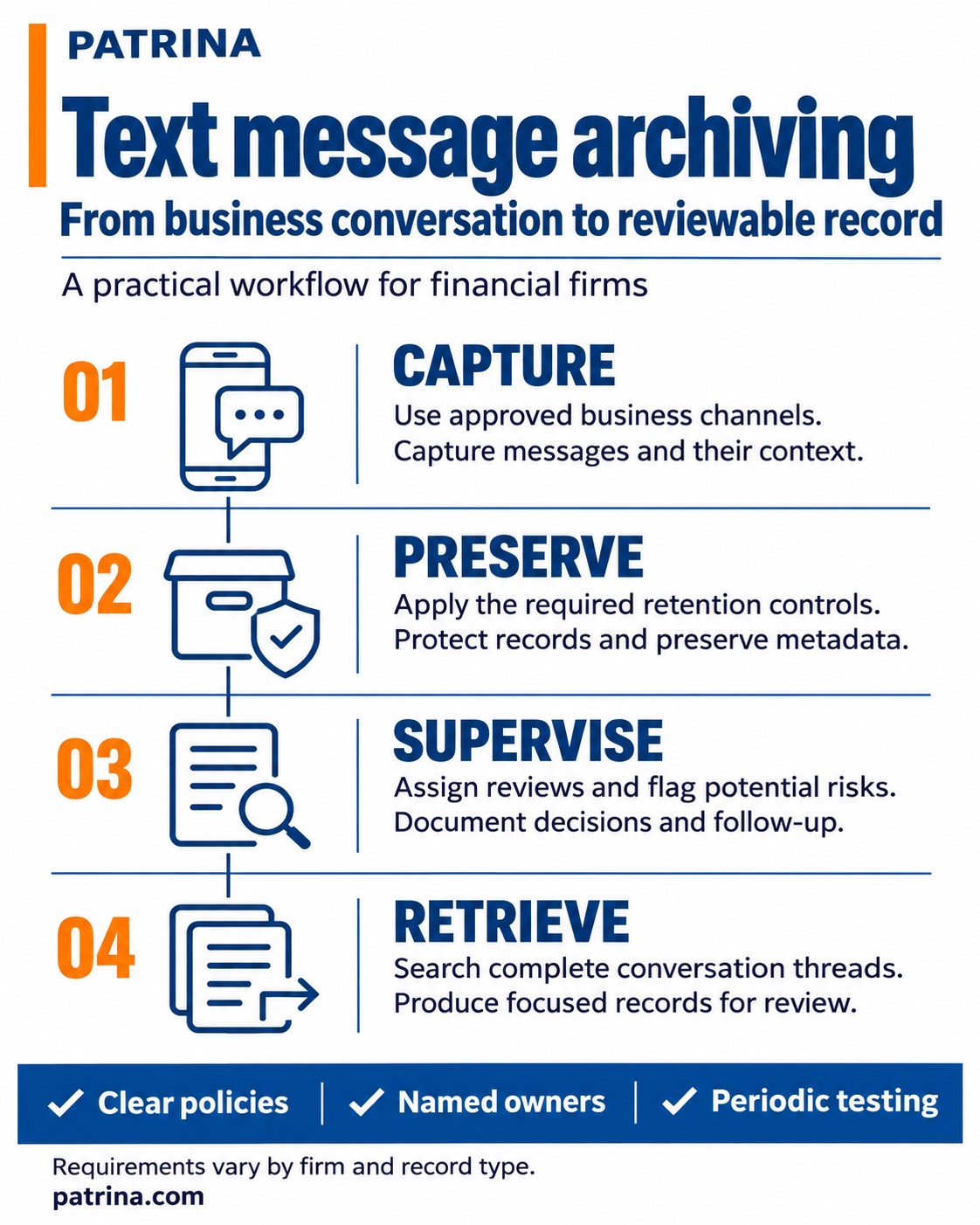
Text Message Archiving Compliance Checklist for Financial Firms
Use this step-by-step checklist to benchmark your firm’s mobile text message archiving readiness before your next SEC or FINRA examination:
-
Conduct a Channel Risk AssessmentSurvey advisors and staff to identify every messaging platform clients currently use to contact them (SMS, iMessage, WhatsApp, LinkedIn DMs, Microsoft Teams, Slack).
-
Update Written Supervisory Procedures (WSPs)Explicitly define which communication channels are approved for business use, which are strictly prohibited, and how approved channels are captured and supervised.
-
Deploy Automated Capture Across Corporate and BYOD DevicesImplement carrier-level archiving, dual-persona mobile apps, or enterprise connectors so every approved channel feeds automatically into your archive.
-
Verify SEC Rule 17a-4 / 204-2 Storage ComplianceConfirm your archive utilizes immutable WORM storage or a compliant time-stamped audit trail, and maintain current Third-Party Downloader (TPD) or Designated Third Party (D3P) undertakings where required.
-
Configure Lexicon and AI Supervisory SurveillanceIntegrate captured mobile messages into your supervisory review queue with regularly updated keywords targeting off-channel migration (e.g., phrases like “text my personal cell” or “ping me on WhatsApp”).
-
Enforce Consequences for Policy ViolationsEstablish a clear, tiered disciplinary matrix—ranging from compliance coaching and formal warnings to compensation clawbacks or termination—and apply it consistently across all seniority levels.
-
Conduct Periodic Sampling and TestingRun quarterly audits comparing CRM activity, trade blotters, and email threads against archived text logs to detect uncaptured off-channel gaps early.
How to Implement a Compliant Mobile Messaging Policy Across Your Team
Rolling out a new data retention policy for mobile devices requires balancing strict regulatory enforcement with practical usability and employee privacy:
- Separate Personal Privacy from Business Oversight
The biggest barrier to BYOD adoption is employee fear that compliance officers will read their personal family texts. By using dual-persona business numbers or enterprise-managed containers, you guarantee that only business communications are captured while personal communications remain strictly off-limits.
- Train Teams on “Channel Migration” Triggers
Teach advisors how to handle clients who initiate business discussions on an unapproved personal number. Establish a mandatory protocol: the advisor must not reply to the business inquiry on the unapproved channel, and must immediately respond via their approved, archived business number while documenting the transition.
- Lead from the Top
SEC enforcement orders consistently highlight cases where senior executives violated the very policies they signed off on. Require managing directors, branch managers, and executives to enroll in mobile text message archiving first, setting a visible standard across the organization.
- Require Annual Attestations
Have every registered representative and covered employee sign an annual compliance attestation confirming they understand your mobile messaging policy, only use approved channels for business, and have disclosed all business-use devices.
Ensuring eDiscovery Readiness for Corporate Text Messages
When an SEC sweep, FINRA examination, or civil litigation occurs, regulators expect rapid, complete, and accurate production of records. True eDiscovery readiness requires far more than simply dumping thousands of raw text lines into a spreadsheet.
To ensure your enterprise text message retention system holds up under legal scrutiny, verify that your platform supports:
- Full Conversational Threading
Individual SMS messages lack context when viewed in isolation. Your archive must reconstruct multi-day back-and-forth conversations into coherent, chronological chat threads.
- Rich Media and Attachment Capture
Modern business texts frequently include PDFs, screenshots of portfolio performance, images, emojis, and voice memos. Your archive must capture and index both the message text and all embedded media files.
- Comprehensive Metadata Preservation
Every archived message must retain sender/recipient phone numbers, participant identities, exact UTC timestamps, device identifiers, message status (sent, delivered, read), and any edit or deletion history.
- Legal Hold Capabilities
Compliance and legal teams must be able to place instant legal holds on specific custodians, date ranges, or keywords, suspending standard retention expiration schedules until an investigation or lawsuit concludes.
- Unified Cross-Channel Search
Regulators rarely ask for text messages in a vacuum; they ask for all communications between an advisor and a client across a specific timeframe. Your archiving platform should allow compliance officers to search email, SMS, WhatsApp, voice, and collaboration chats simultaneously from a single interface.
Choosing the Right Archiving Solution
Not all archiving vendors are built to withstand the rigors of financial services regulation. General enterprise backup tools or basic telecom logging features frequently fall short of broker-dealer compliance standards, leaving firms exposed during audits.
Features to Look for in the Best Text Message Archiving Software for Financial Advisors
When evaluating text communication archiving platforms for your firm, prioritize solutions that deliver the following enterprise capabilities:
- Guaranteed SEC Rule 17a-4 & FINRA Rule 4511 Compliance
Look for native WORM storage or compliant immutable audit trails, complete with automated retention scheduling and third-party regulatory attestations.
- Multi-Channel Native Capture
Ensure the platform seamlessly captures native SMS/MMS, iMessage, WhatsApp, WeChat, and enterprise collaboration tools alongside corporate email—eliminating fragmented data silos.
- Flexible Deployment for Corporate and BYOD Models
Whether your firm issues corporate smartphones or supports BYOD policies, the software should offer frictionless capture without degrading battery life or disrupting the user interface.
- Integrated Supervisory Surveillance Workflows
Choose a system that pairs audit trail management with intelligent lexicon filtering, customizable risk scoring, and documented supervisory sign-off trails so compliance teams can prove active oversight under FINRA Rule 3110.
- High-Speed Search and Regulator-Ready Exports
Verify that compliance officers can run granular boolean searches across millions of messages in seconds and export complete, tamper-evident production packages in formats accepted by the SEC and FINRA.
- Dedicated Financial Services Expertise
Partner with a provider that understands the nuances of SEC exams, FINRA cycle audits, and RIA recordkeeping requirements, offering responsive support when regulatory deadlines are on the line.
Off-channel communication enforcement is a permanent fixture of the financial regulatory landscape. By replacing manual guesswork and unenforceable bans with automated, compliant text message archiving, your firm can empower advisors to connect with clients on the channels they prefer—while keeping your business completely protected from regulatory penalties.
Protect your firm from costly SEC and FINRA penalties. Schedule a Patrina Compliance Demo Today!