Validate the Approved Business-Number Route
Confirm number types, provisioning, porting, carrier and device support, and group-message behavior for your proposed configuration.

Keep business texts reviewable
Texting makes client communication immediate, but business conversations can become difficult to retain, supervise and retrieve when they remain outside your firm’s approved systems.
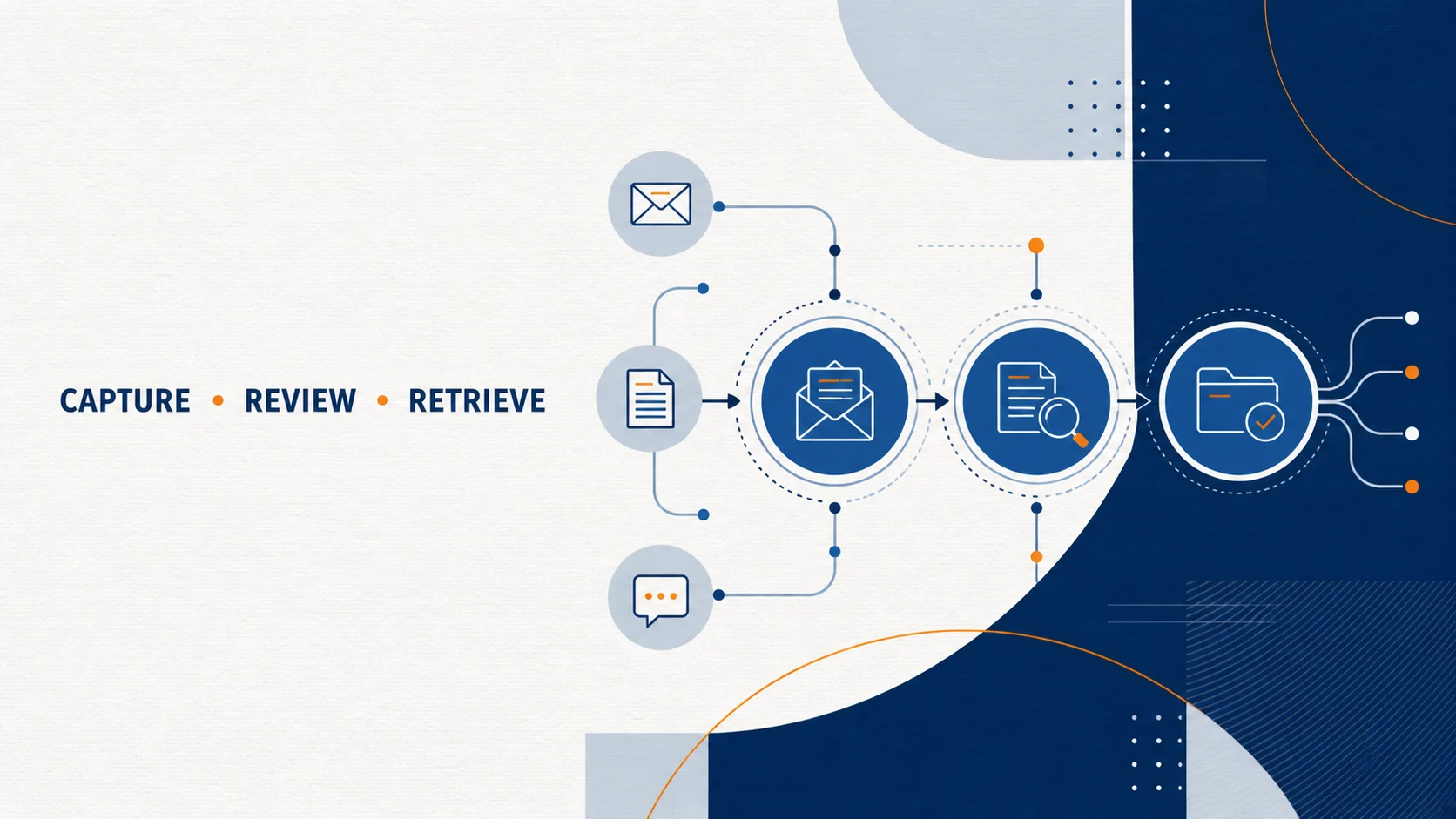
Bring-your-own SMS capture from providers such as MyRepChat, CellTrust and FirmScribe can connect approved business texting with archiving workflows for search, review and retrieval—keeping business texts accessible beyond the employee’s phone.








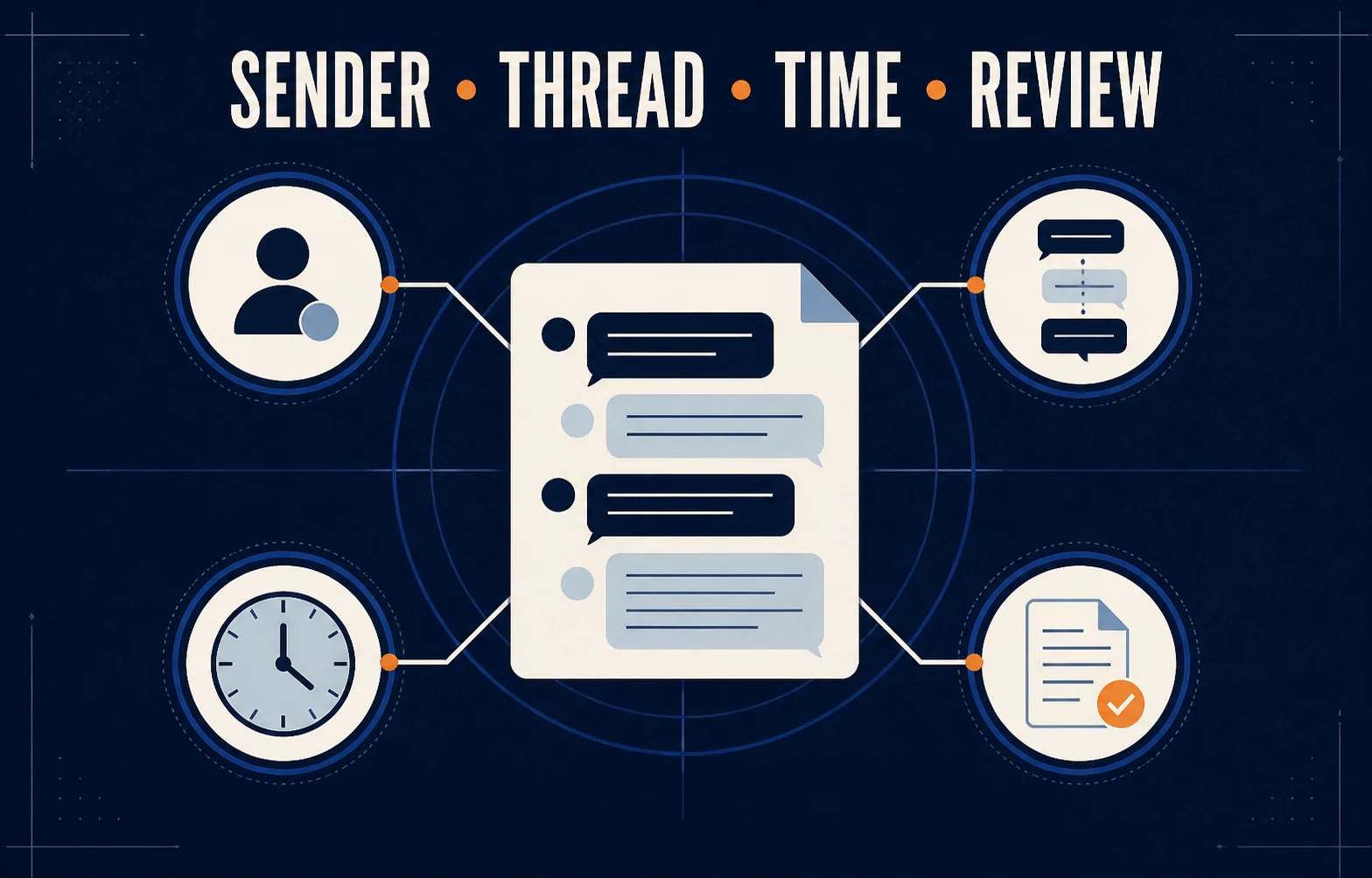
From approved texting to reviewable records
Business texting becomes harder to supervise when conversations remain on personal devices or scattered across screenshots.
Bring-your-own SMS capture from providers such as MyRepChat, CellTrust and FirmScribe can connect approved business texting to message archiving and supervision capabilities, giving your authorized team a centralized workflow for search, sampling, assignment, flagging and reporting.
Bring-your-own SMS capture can route business texting through an approved business number and supported provider, such as MyRepChat, CellTrust or FirmScribe. Clients can respond through ordinary SMS where supported, without requiring a separate client application.
You gain a defined business route that connects client conversations to the approved user, number and archiving process.
Patrina’s message archiving capabilities include full indexing, saved searches, customizable flagging lexicons, percentage sampling, follow-up flags and automated review assignments.
Use these tools to locate conversations, select messages for review, assign responsibility and document follow-up within the same workflow.
Use identifiers such as the supervised user, business number, participants and date range to narrow results while preserving the context needed to understand the conversation.
Your compliance, legal and operations teams can work from the archived record rather than relying on screenshots or other device-level evidence after the fact.
“We use Patrina primarily to help us monitor email communication between the advisor and the client. In addition, we find Patrina useful in helping us monitor external text messaging.”
Joel A. Diaz
Managing Member, Anchored Wealth Management
Capabilities that support the record chain
Confirm number types, provisioning, porting, carrier and device support, and group-message behavior for your proposed configuration.
Evaluate the complete capture path: which messages enter the archive, what event history is preserved, how capture failures are identified and how subsequent review activity is recorded.
Test which fields you can search, including message content, sender, recipient, user, business number, date range, attachments and review status—and confirm that results preserve conversation context.
Define what triggers a review, who receives it, how false positives are handled and how sampling aligns with your written procedures.
Patrina’s standard compliance review includes automated review assignments, group-based access controls, reassignment and escalation. Test how these controls determine who can access sensitive conversations, who owns each review and how unresolved items are escalated.
Validate report fields, export formats, conversation rendering, attachments, audit history, access controls and the respective responsibilities of your team.
Use a representative or fictional scenario that includes an employee, approved business number, supported device or application, inbound client reply, attachment or media, compliance review and later retrieval.
The demo should show what enters the archive, which identity and conversation context is preserved, how the message moves into review and what happens when an expected record fails to arrive.
Capture coverage
Saying “we archive text messages” is not enough. You need to know which users, numbers, devices, applications and message types are actually captured. A controlled SMS program starts by mapping and validating the complete message route before production texting begins.



Bring-your-own SMS capture lets you connect approved providers such as MyRepChat, CellTrust and FirmScribe to your broader archiving and supervision workflow.
The specific capture method, supported message types, account coverage and preserved data depend on the provider and configuration. Confirm those details before approving a texting route.
For each step, document the owner, supported configuration and exception process.
When messaging features are enabled, SMS/MMS data may include message content, sender and recipient phone numbers, timestamps, delivery information and attachments or media. Treat these as evaluation criteria rather than assuming every field or source is available in every deployment.
Confirm whether your approved implementation supports:
Confirm each item with Patrina and your SMS capture provider. Document unsupported routes in your policies and training rather than assuming that a supported messaging channel provides universal coverage.
Define your approved SMS sources, capture paths and archive requirements before you deploy business texting. Use the resulting route map to identify coverage gaps, test exceptions and establish a documented path from message creation to review and production.
The mobile-messaging reality
SMS messages feel simple because the interaction is short and familiar. The recordkeeping process is not.
A single conversation can involve a personal device, business number, messaging application, carrier, multiple participants, media and replies that follow a different route.
The challenge is not message volume alone. It is maintaining the connection between each conversation, the people involved, your policies and the review process responsible for it.
Clients may already know an employee’s personal number, and employees may default to a device’s native messaging interface because it is convenient.
A conversation that starts through an approved channel can quickly move somewhere else. If that route is unsupported, your archive cannot preserve what it never receives.
The key question is not whether employees have phones. It is which combinations of user, number, application and message type are authorized—and how you detect communication outside those boundaries.
Your technology, policies, training and exception procedures should all reinforce the same approved route.
Message text alone may not show who sent it, which business number was used, whether a reply belongs to the same conversation, when media was attached or which supervised person owns the interaction.
Reviewers need enough metadata and message sequence to understand the conversation without reconstructing it from screenshots, contact lists and memory.
Treat participant association, timestamps, thread order and attachment handling as evaluation criteria. Test how each element appears during review and in reports or production output.
An archive can contain millions of messages while exceptions remain unreviewed. Effective supervision requires a visible path from search, lexicon match or sampling to assignment, disposition, escalation and completion.
Preserving a message is only part of the process. You also need to document what happened after it was selected for review.
Your workflow should clearly show which message or conversation was selected, who reviewed it, what required follow-up and where the resulting action was documented.
Use a real handoff to evaluate fit, ownership and visibility.
Three moments when the record chain matters
Clients text an advisor’s known number about meeting logistics, documents or service questions, but your firm requires business conversations to follow a defined route.
Advisor or registered representative, technology administrator and compliance owner.
Authorize the user and connect an approved business number through a supported SMS capture provider, such as MyRepChat, CellTrust or FirmScribe. The user communicates through the supported device or application, while the client can reply by SMS where supported.
Captured messages enter the Patrina archive according to the validated configuration, where authorized reviewers can search and review them.
You establish a defined business identity and capture path instead of relying on an employee’s personal message history. Your policies should also explain what to do when an advisor uses an unapproved number or application.
A message is selected through percentage sampling, a saved search or an approved lexicon.
Compliance analyst, supervisor or CCO, supervised user and escalation owner when follow-up is required.
Archived messages are assigned to an authorized reviewer, evaluated in conversation context, flagged for follow-up when appropriate, and reassigned or escalated according to your review process.
A complete audit history documents the activity.
Your review process creates a traceable path from message selection to reviewer, decision and follow-through—not simply an undocumented review of stored content.
A review, complaint or user report indicates that business texts should exist, but the conversation cannot be found by employee, number or date range.
Compliance owner, technology administrator, affected user, archive administrator and provider support when needed.
Reconstruct the route, user identity, business number, device or application, message direction, counterparty and capture provider. Determine whether the route was approved and supported, improperly used, incorrectly provisioned or affected by a capture failure.
Document the gap, preserve available evidence, correct the configuration or policy as appropriate and retest the route before closing the issue.
An empty search does not become false assurance. Your team can distinguish between a message that was not found and a communication path that was never captured—and document the appropriate remediation.
Rules follow the business communication
SMS archiving can support regulated and records-driven organizations, but recordkeeping obligations vary by business, activity and regulatory status.
A broker-dealer, SEC-registered investment adviser, state-registered adviser and non-financial organization may have different requirements for business communications and retention.
Map your SMS program to the content being communicated, business activity, registration status, applicable rules, written policies and approved communication routes. Avoid applying a single retention period or recordkeeping standard across every business or communication.
FINRA Regulatory Notice 17-18 states that a firm intending to communicate, or permit associated persons to communicate, about its business through text messaging or chat must first ensure it can retain required records under applicable SEC and FINRA rules.
The Notice also explains that the content of a communication determines what must be retained.
The practical approach is not to assume that every text requires the same treatment. Define your permitted texting routes, confirm that required communications can be retained and supervise those routes under your applicable rules and procedures.
FINRA Rule 4511 and SEC Rules 17a-3 and 17a-4 provide key books-and-records requirements for broker-dealers.
In a 2020 enforcement action, the SEC described a broker-dealer’s failure to preserve business-related text messages sent or received on personal devices. Some responsive messages could not be produced because they were outside firm-sponsored systems.
Use this example to evaluate your architecture and policies—not as evidence that any particular product guarantees compliance. Your controls should address approved communication routes, user behavior, capture exceptions, retention, supervision and production.
Advisers Act Rule 204-2 identifies specified books and records for SEC-registered investment advisers, including certain communications and other required records. Whether a particular text must be retained depends on its content and the applicable provision.
The fact that a message appears on a phone does not determine its recordkeeping treatment. Map your SMS use to your registration status, activities, policies and applicable federal or state requirements with qualified compliance or legal professionals.
FINRA guidance and SEC broker-dealer recordkeeping rules should not be presented as universal requirements for every investment adviser.
A written prohibition on unapproved texting does not capture a prohibited message. Likewise, a capture tool does not tell users how to respond when a client texts an unapproved number.
Documented supervision — Record reviews, exceptions, escalations and follow-through.
Regulatory Context
Recordkeeping requirements depend on your registration status, activities, communications and applicable federal or state rules. This content provides general information and is not legal or compliance advice.
Use qualified compliance and legal professionals to determine which requirements apply to your business and how they should be implemented.
Choosing an SMS archive
Use a representative message route in the demo and follow it in both directions before evaluating broader capture claims.
A useful demonstration should show what the archive receives, which identity and context are preserved, how a reviewer works with the conversation and what happens when a message or data field falls outside the supported configuration.
Can you demonstrate inbound and outbound capture for every combination of user, number, device, application and provider your firm plans to authorize?
List each population that may send business texts—employees, advisors, registered representatives, contractors, branches and shared service teams. For each, document the approved business number, application, device model and SMS capture provider.
Classify every route as supported, prohibited or unresolved.
Which content and metadata survive from the live conversation through reviewer search and production?
Confirm that reviewers can identify participants, originating and destination numbers, timestamps, message sequence and conversation context. For MMS and file attachments, test how media is preserved, rendered, searched and produced.
Where applicable, also test edits, deletions, delivery status, group messages and long conversations.
How will your administrators identify a missing user, failed archive connection or unsupported route before a request exposes the gap?
Determine how you are alerted when a user is not provisioned, a business number changes, an archive connection fails or a conversation moves to an unsupported application.
Define who investigates each exception, what evidence is captured and how remediation is documented.
Can you compare every approved route with actual archive activity—and identify exceptions when they do not match?
Compare your approved user × number × device/application matrix with provisioning records and archive activity. Define how you detect newly added users, changed numbers, inactive routes or populations with unexpectedly low or absent activity.
Regular reconciliation can help identify coverage drift before a complaint, examination or production request.
When an expected route fails, can your team identify the failure, preserve evidence, assign remediation and verify recovery?
Use a controlled test failure, such as an unprovisioned user, changed business number, disconnected route or unsupported application.
Verify what becomes visible, how your team distinguishes policy misuse from technical failure, who owns the investigation and what evidence is required before returning the route to service.
Test one representative user, two-way SMS, one media item if supported, one provisioning exception and one unsupported route.
The most meaningful evidence is not a successful message appearing in a clean diagram. It is your team’s ability to detect, investigate, remediate and verify a failed capture path.
Bring one real client or record journey and ask Patrina to show how the platform supports it.
SMS archiving software archives supported business text messages and preserves them outside the user’s live phone history so authorized teams can search, review and retrieve them.
A complete workflow also preserves useful context, such as the user, sender and recipient numbers, timestamps and conversation history, while documenting relevant supervisory activity. Capture methods and available data fields vary by service provider, so please inquire about supported capture solutions.
Email capture typically centers on mail systems, domains, mailboxes and message headers. SMS capture may depend on business-number provisioning, a carrier or integrated provider, an application, device permissions or another mobile route.
Email and SMS can share an archive and review interface, but an email connector does not automatically capture SMS. Your SMS program therefore needs a clear map of approved numbers, devices, applications and capture providers.
It depends on the approved architecture. Capture may use a separate business number, application, carrier-level integration, device permissions or another supported method.
Patrina’s archive can support approved providers such as MyRepChat, CellTrust and FirmScribe, depending on the configuration.
Confirm your approved BYOD route, privacy boundaries, supported operating systems and how personal and business numbers are handled. Do not assume that a solution captures every native text on every personal device.
There is no single answer for every firm or every text.
For FINRA member firms, Regulatory Notice 17-18 states that the content of a communication determines what must be retained and that firms permitting business communication through texting or chat must first ensure required records can be retained under applicable rules.
Investment advisers and other organizations operate under different recordkeeping frameworks. Map your communications and business activities to the rules and policies that apply to your organization.
The Notice states that a firm intending to communicate, or permit associated persons to communicate, about firm business through a text-messaging application or chat service must first ensure it can retain required records.
It also emphasizes that the content of a communication determines what must be retained. The Notice provides FINRA guidance and should not be treated as a universal interpretation of every federal or state recordkeeping requirement.
Patrina’s archiving provides indexing, saved searches, lexicon flagging, sampling, automated review assignments, access controls, audit trails and reporting for reviews or regulatory requests.
During evaluation, confirm the SMS search fields, conversation and media display, export and report formats, permission controls, service responsibilities and applicable commercial terms.
Do not assume that mobile messaging channels share the same capture method. SMS, MMS, iMessage, RCS and WhatsApp may require different technologies or integrations.
While evaluating your message capture solution, discuss which message types or applications are captured, how the data is delivered and presented to the archiver.
Ask Patrina to verify compatibility with your SMS capture provider. Do not infer iMessage, RCS, WhatsApp or native-carrier capture are standard with your capture provider.
See Patrina archiving in action
Bring a real process to the conversation. A focused demonstration can show the relevant product path, clarify configuration questions and identify what your team should validate next.